Recruitment |
|
We are looking for new PhD students and post-doctoral research fellows to join us. If you are interested in research at the interface of bioengineering, biomedical science, chemistry, materials, biosensors, AI and metabolism, please contact Prof. Chen at chenpeng@ntu.edu.sg with your CV.
Students with an outstanding academic record and other achievements may also be competitive for the Nanyang President's Graduate Scholarship (NPGS) or Provost Graduate Award (PGA), for which the current stipend for Singapore citizens is S$5,300 per month.
Postdoctoral researcher applicants with an exceptional publication record may consider applying for the NTU Presidential Postdoctoral Fellowship (PPF).
Applicants with a strong background in artificial intelligence may consider applying for the NTU AI-for-X Postdoctoral Fellowship.
Prof. Chen will work closely with suitable applicants in preparing and submitting their fellowship applications.
|
What are we currently trying to understand?
Metabolism is highly dynamic. Our body continuously adapts to what we eat, what we do, and changes in our physiological state. Yet, most metabolic measurements today are based on a single biomarker measured at a single time point.
Continuous glucose monitoring (CGM) has transformed our understanding and management of diabetes, but glucose tells only part of the story. When glucose availability is low, the body increasingly mobilises fat and produces ketone bodies. Lactate production and utilisation also change markedly during exercise, hypoxia and many pathological or metabolically stressed states.
Our goal is therefore to move from continuous glucose monitoring to continuous metabolic monitoring.
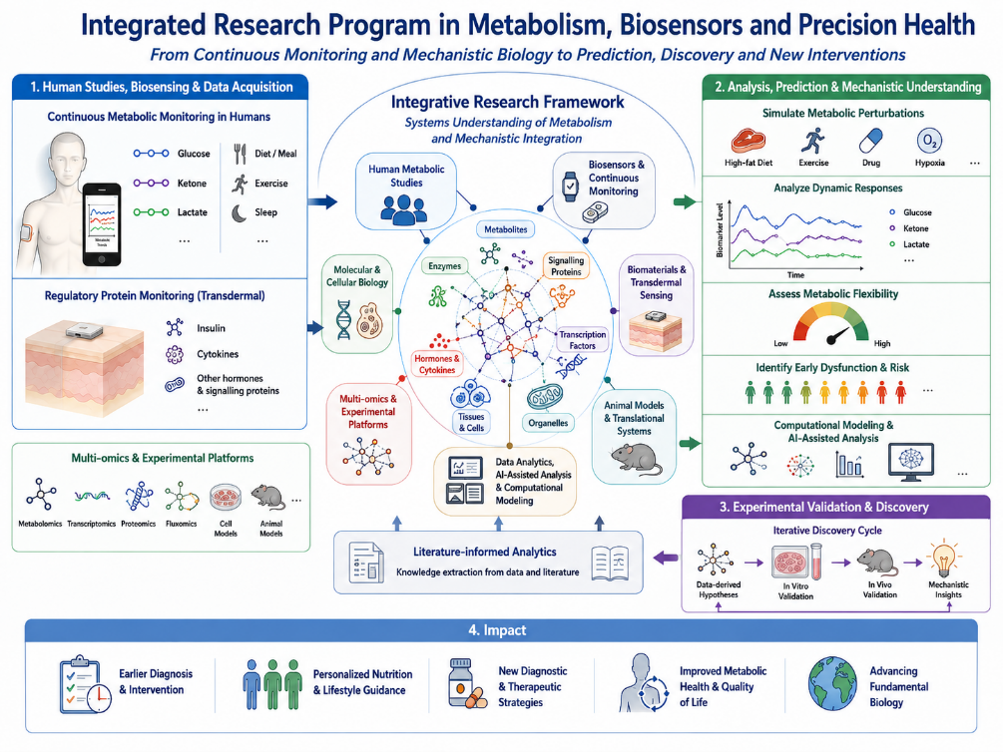
We are equipped with the capability of continuous simultaneous monitoring of glucose-ketone-lactate and have recruited human volunteers for collecting continuous multi-metabolite data under controlled dietary and lifestyle interventions.
This creates a unique opportunity to ask questions such as:
Can we predict how an individual's glucose, ketone and lactate levels will respond to a meal or exercise? Can these dynamic responses reveal metabolic dysfunction before conventional clinical tests do? Can they predict an individual's future risk of metabolic disease?
We are developing AI models and advanced analytical approaches to interpret these rich longitudinal datasets and connect dynamic metabolic responses with health and disease.
|
Beyond metabolites: monitoring the regulators of metabolism
Metabolism is controlled by hormones such as insulin and many other signaling proteins. We are developing transdermal continuous protein-monitoring technologies to measure these regulators alongside metabolites.
Ultimately, we hope to obtain a much more complete picture of an individual's metabolic state by continuously monitoring both metabolites and their regulatory signals.
A central concept we want to understand and quantify is metabolic flexibility—the ability of the body to appropriately switch between metabolic pathways and fuels, including glucose, fatty acids, ketones and lactate, in response to changes in nutrient availability, energy demand, and physiological status.
By integrating human studies, biosensor development, molecular and cellular experiments, animal models, AI and data analytics, we aim not only to measure metabolic flexibility, but also to uncover the molecular mechanisms underlying it. This knowledge could eventually enable earlier diagnosis, personalised dietary interventions and new therapeutic strategies for metabolic disorders.
In parallel, we are developing AI-driven metabolic reasoning systems that use LLMs, knowledge graphs and graph AI to learn from large-scale biomedical literature, construct dynamic metabolic signalling networks, predict perturbation responses and generate experimentally testable hypotheses. These predictions will be validated through cellular perturbation, multi-omics and disease-relevant models, creating a closed-loop AI-to-experiment discovery platform.
|
Where could you fit in?
This is a highly ambitious and interdisciplinary research programme. No single person is expected to do everything.
Depending on your interests and background, your research could focus on areas such as:
- biosensors and continuous biomarker monitoring;
- biomaterials and transdermal sensing;
- molecular and cellular mechanisms of metabolism;
- human metabolic studies;
- AI/ML, LLMs, graph AI, bioinformatics, computational biology, and analysis of longitudinal physiological and molecular data;
- development of new diagnostic or therapeutic strategies.
Students or young researchers from bioengineering, chemical engineering, chemistry, biological sciences, materials science, computer science, data science and related disciplines can therefore find their own niche while working closely with researchers from different backgrounds.
We are looking for talented researchers who are curious, ambitious and willing to work across traditional disciplinary boundaries. If you enjoy asking difficult questions and want your research to have the potential for both fundamental scientific discovery and real clinical impact, I encourage you to consider joining us.
|
|
|

|
|