Research Topics
ATOM-THIN MATERIAL
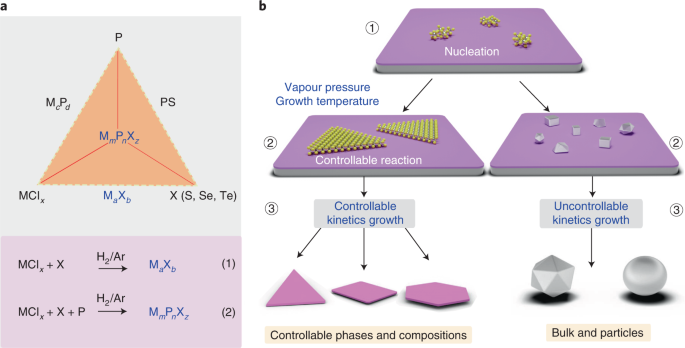
A competitive-chemical-reaction-based growth mechanism was developed to precisely control the nucleation and phase composition of two-dimensional transition metal chalcogenides and phosphorous chalcogenides. This advance enabled the synthesis of 67 distinct, high-quality 2D crystals with tunable properties, facilitating the systematic exploration of novel ferromagnetic and superconducting behaviors.
Composition and phase engineering of metal chalcogenides and phosphorous chalcogenides
Nature Materials (2023)
ELECTRONIC & OPTOELECTRONIC

Electronic
Harnessing the native oxide of liquid metals to engineer superior gate dielectrics for 2D electronics. We demonstrate a van der Waals integration technique that achieves ultrathin Ga₂O₃ layers with a high dielectric constant, pushing MoS₂ transistors toward the theoretical limit of subthreshold swing with low leakage.
Integration of high-κ native oxides of gallium for two-dimensional transistors
Nature Electronics (2024)
Optoelectronic
Exploiting the ferroelectric bulk photovoltaic effect in 3R-stacked WS₂ to surpass the Shockley-Queisser limit. We engineer a retinomorphic device with nonvolatile, reconfigurable photoresponsivity that can be modulated from positive to negative. This all-van der Waals architecture enables high-accuracy in-sensor computing for advanced machine vision applications.
Reconfigurable and nonvolatile ferroelectric bulk photovoltaics based on 3R-WS₂ for machine vision
Nature Communications (2025)

CATALYSIS
Micro-cell-Storm Platform
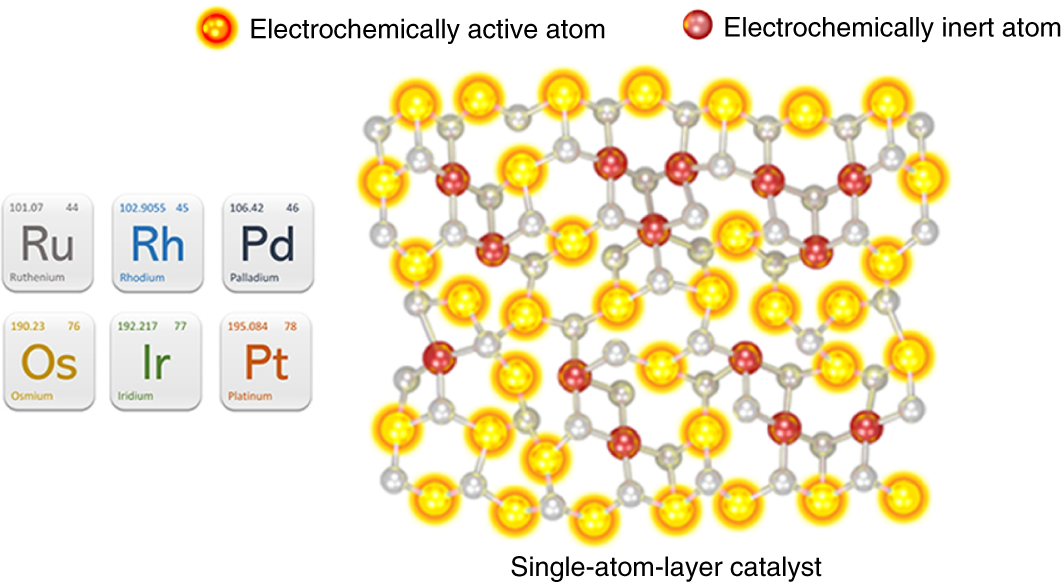
Realizing ultimate atom-utilization efficiency in noble metal catalysts via a low-temperature amorphization strategy. We fabricate wafer-scale amorphous PtSex films that function as single-atom-layer catalysts with ~26 wt% efficiency, delivering high-flux hydrogen production and current densities of 1,000 mA cm⁻² comparable to pure platinum.
Amorphizing noble metal chalcogenide catalysts at the single-layer limit towards hydrogen production
Nature Synthesis (2024)
Electrochemical / Optoelectrochemical Catalysis
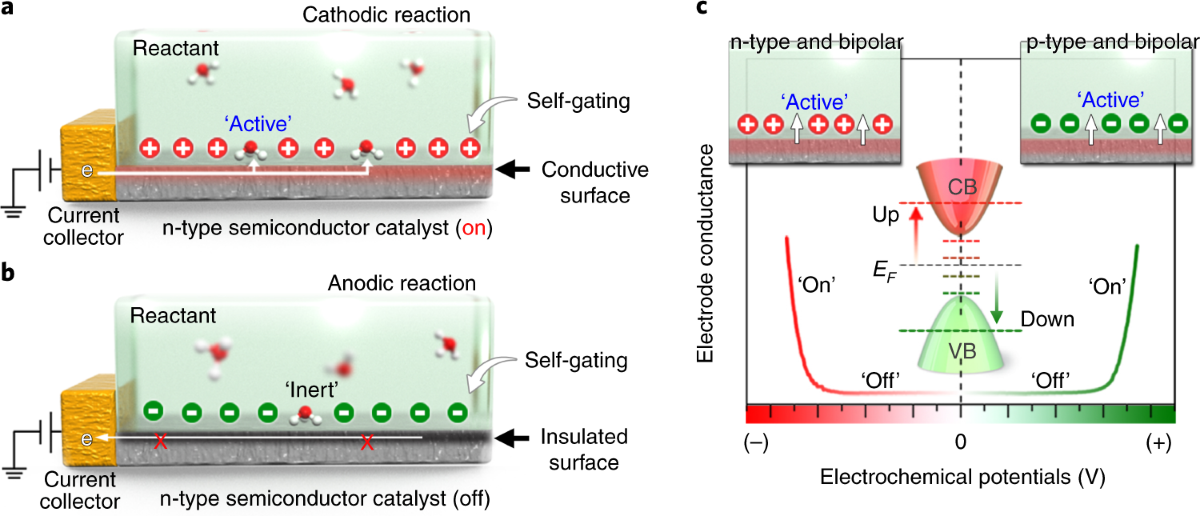
Revisiting the semiconductor–electrolyte interface to explain high carrier accumulation in ultrathin catalysts. We unravel a universal self-gating phenomenon through in situ measurements, demonstrating that n-type semiconductors favor cathodic reactions like hydrogen evolution while p-type prefer anodic reactions like oxygen evolution, establishing a strong correlation between semiconductor type and electrocatalytic performance.
Self-gating in semiconductor electrocatalysis
Nature Materials (2019)
AI FOR SCIENCE
Tools and Platform
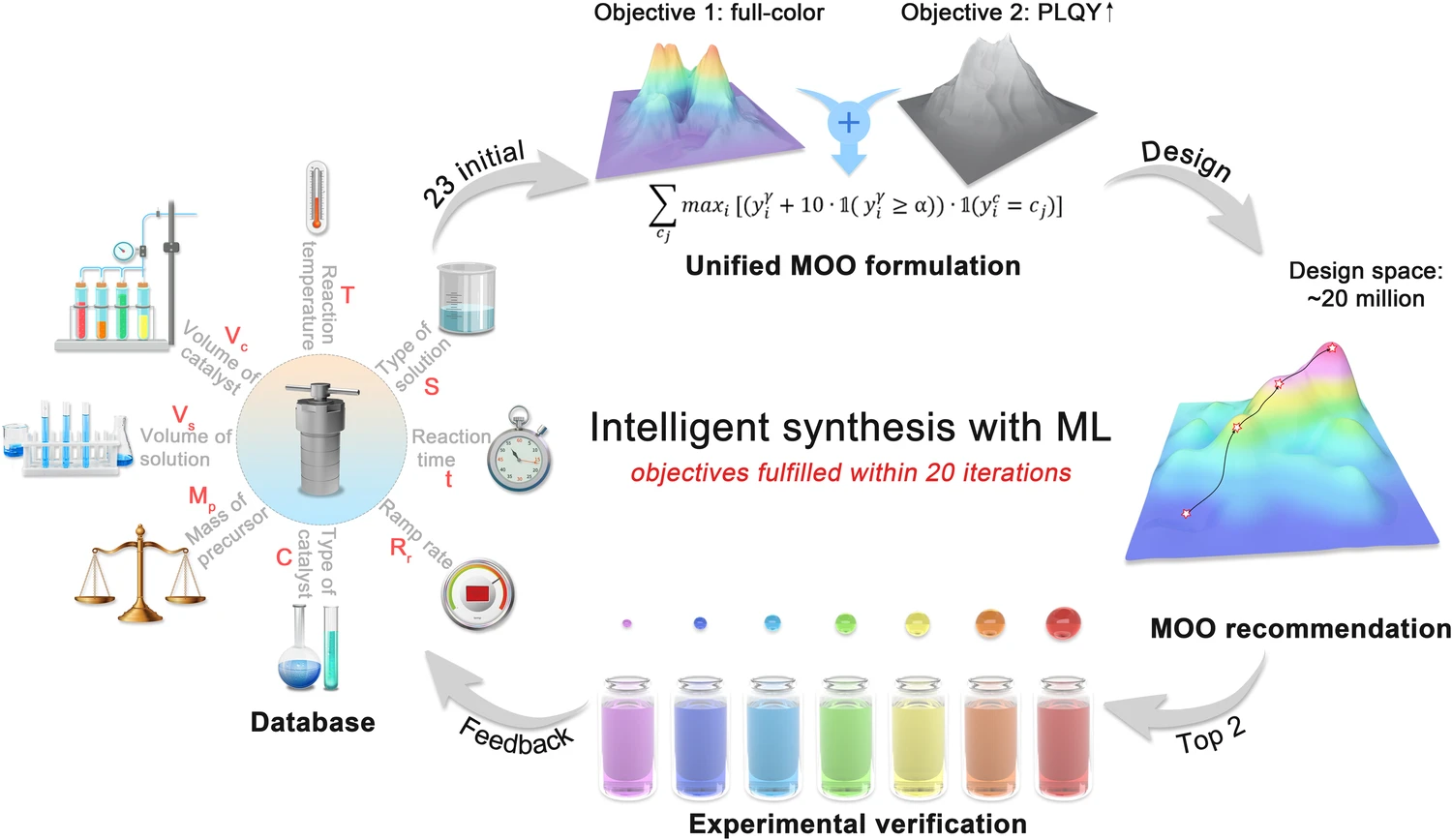
Integrating machine learning into the material lifecycle—from guiding the synthesis of quantum dots and nanoribbons to building neuromorphic devices that mimic the brain.
Machine learning‑guided realization of full‑color high‑quantum‑yield carbon quantum dots
Nature Communications (2024)
Agent System
Moving beyond prediction. With MATAI and AutoMAT, we are building hierarchical autonomous systems that close the loop on alloy discovery and property optimization.
MATAI: A generalist machine learning framework for property prediction and inverse design of advanced alloys

INDUSTRIAL APPLICATION
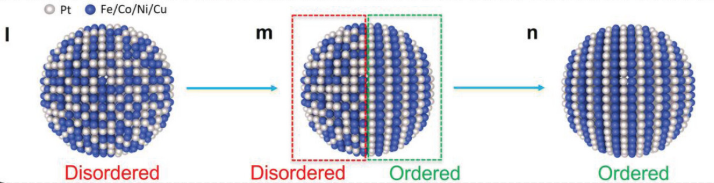
Alloy
Harnessing lattice disorder and thermal engineering to create robust intermetallic catalysts that meet industrial standards for stability and electron transfer speed.
Ordering dependent hydrogen evolution and oxygen reduction electrocatalysis of high entropy intermetallic Pt₄FeCoCuNi
Advanced Materials (2023)
Composite
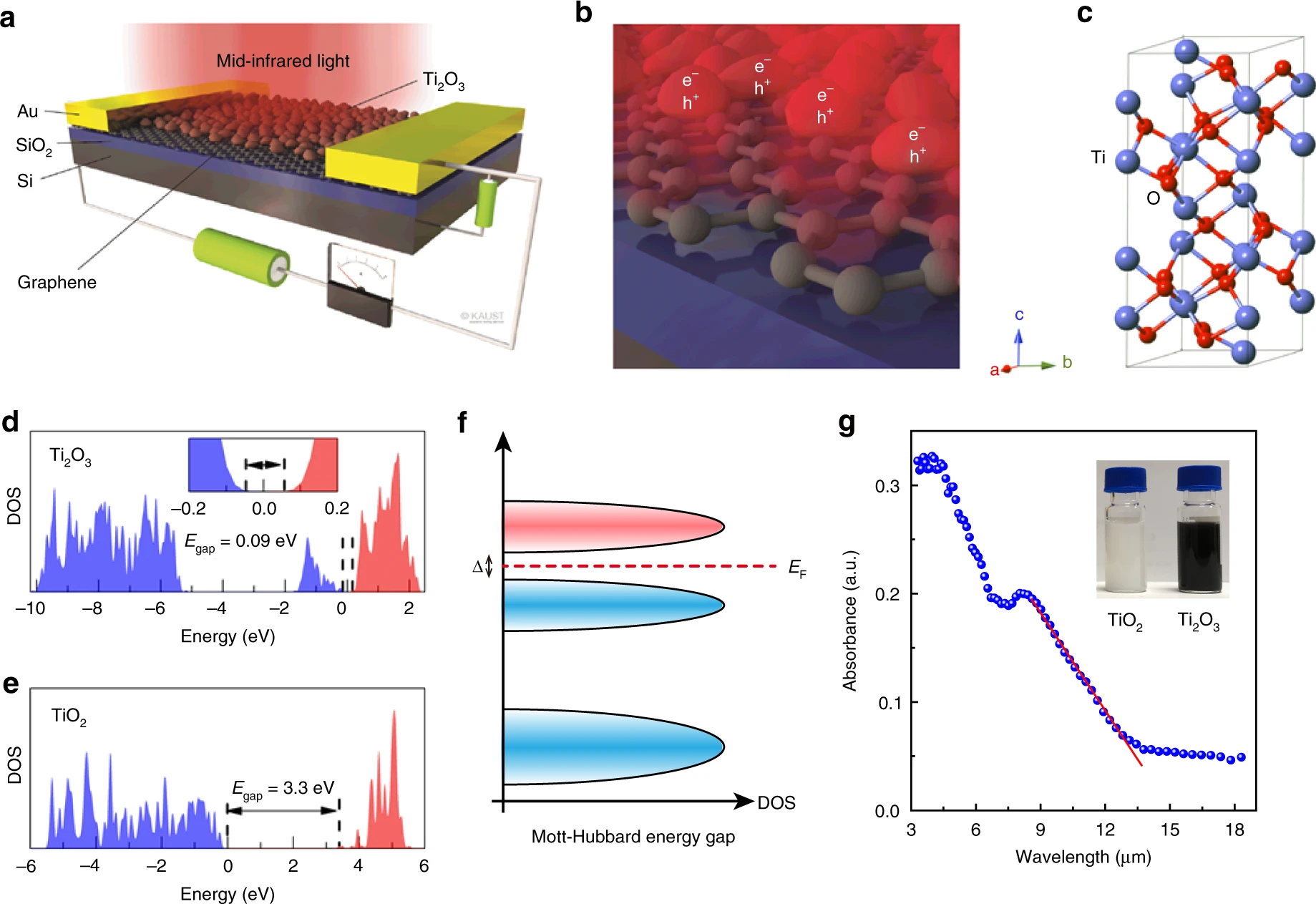
Coupling the broadband absorption of narrow bandgap oxide nanoparticles with the ultrafast carrier transport of graphene. We engineer van der Waals hybrid interfaces to overcome intrinsic material limitations, creating high-performance, room-temperature photodetectors for the mid-infrared spectrum.
Narrow bandgap oxide nanoparticles coupled with graphene for high performance mid-infrared photodetection
Nature Communications (2018)
IR (Infrared)
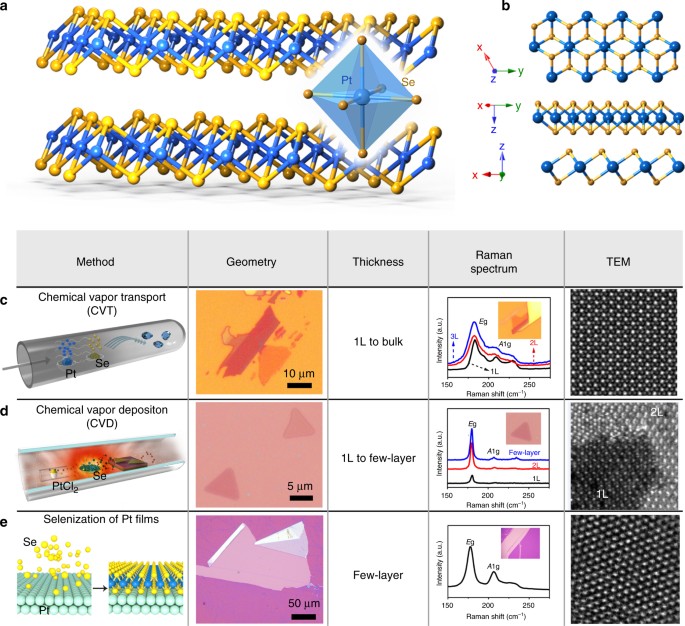
Demonstrating experimentally that 2D atomically thin PtSe₂ possesses a variable bandgap in the mid-infrared range via layer and defect engineering. We show that bilayer PtSe₂ combined with defect modulation exhibits strong light absorption, enabling the realization of a broadband mid-infrared photoconductive detector and establishing 2D noble metal dichalcogenides as a promising platform for high-performance optoelectronic devices.
Atomically thin noble metal dichalcogenide: a broadband mid-infrared semiconductor
Nature Communications (2018)