Join the group

PhD students, research staff and postdoctoral fellows in RF, mm-wave and terahertz IC design.

Who we are looking for

PhD students interested in RF, mm-wave and terahertz integrated circuits. Research staff with a bachelor's or master's degree. Postdoctoral fellows with a PhD in RF or mm-wave design, including one position on a project with MIT.

Send your CV by email. Only candidates with a strong interest, a good background and a firm commitment to finishing the PhD need to apply. All nationalities are welcome.

What a PhD here looks like

  • Chips that get madeAn average of 2 to 3 CMOS tape-outs a year on advanced 28 nm RF technology, plus GaN-on-Si and GaN-on-SiC runs.
  • A full-sized groupAbout 10 PhD students and several postdoctoral fellows working on related projects, so there is always someone to discuss a design with.
  • 3.5 to 4 yearsThe average time to graduate for students in the group.
  • Industry-relevant workProjects with industry partners such as Keysight and Huawei, and the MIT-NTU LEES programme. You learn the whole analog, RF, mm-wave and terahertz IC flow.

Technologies you may use

    Exposure can also include FinFET and gate-all-around nanowire silicon, carbon nanotube devices and silicon integrated passive devices.

    Typical PhD projects

    Your exact topic is agreed with Prof. Boon, with a clear objective for graduation.

    Block design in depth

    High-speed sample-and-hold, LNA, PA, mixer, VCO and frequency divider.

    Systems and architectures

    ADC, DAC, frequency synthesizer, receiver and transmitter.

    Components for advanced technologies

    mm-wave and terahertz inductors, transformers, RF switches, power combiners and splitters.

    See the research page for current work and publications for what students have published.

    Funding

    These are the main routes to a funded PhD place at NTU. Dates are the usual ones for the August intake. Check each official page for the current year before you apply.
    How to apply

    1. Email Prof. Boon with your CV.It also helps to include your transcript, a few lines on your circuit-design experience, and any projects or papers you are proud of. Use a clear subject line such as "PhD enquiry: your name".
    2. Wait for a reply.Only a few students can be taken each year, and only shortlisted candidates are contacted. If you are a good fit but there is no place, Prof. Boon may recommend you to other professors.
    3. Apply to NTU.Follow the NTU graduate admissions procedure. The timeline follows the NTU PhD application schedule.
    4. Apply for a scholarship.Use one of the schemes above. Good undergraduates at NTU, for example final-year project students, can also be encouraged to apply.

    Where alumni go

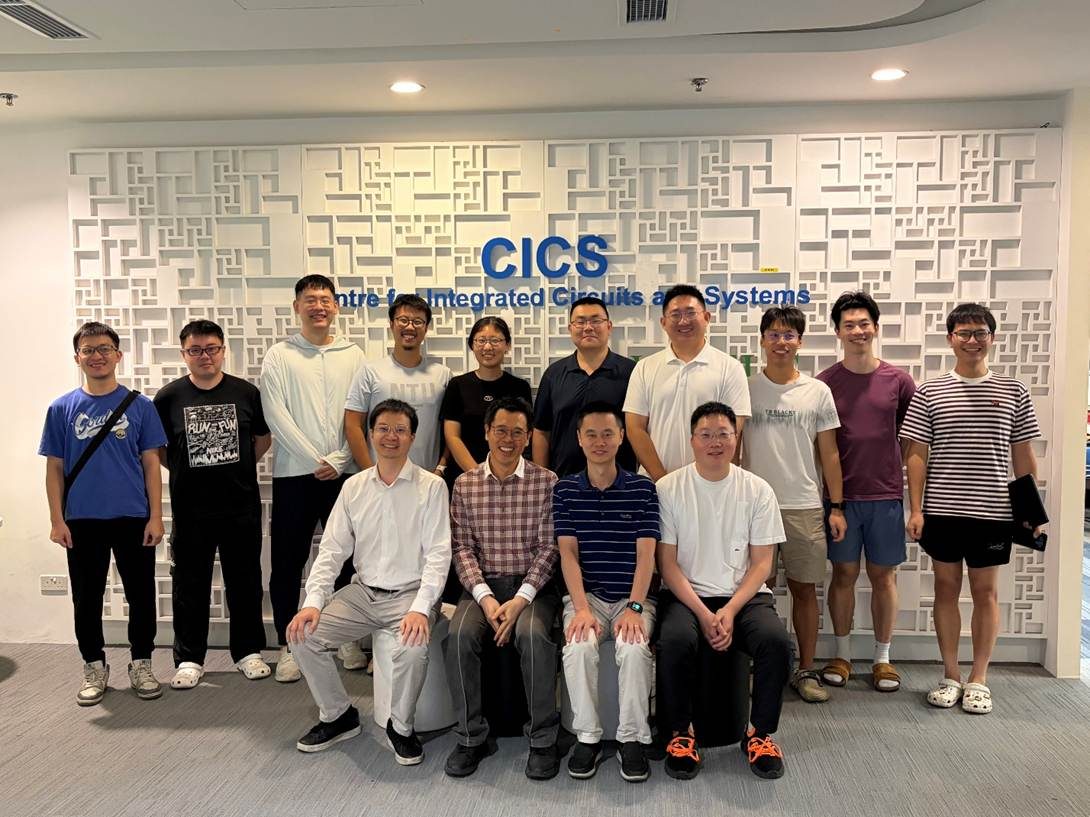
    The research group standing together in front of a wall with the CICS logo
    Part of the group at NTU.

    Questions

    Ready to apply?

    Send your CV to ECCBOON@ntu.edu.sg. Feel free to pass this page on to friends, including those overseas.